

Africa’s Data Center Boom Meets an Electricity Reality Check
Published: 29th April 2026
Data is increasingly becoming central to economies, and with its growing importance comes an increase in data centers. These are facilities designed to store, process and distribute digital information. Africa alone has a total of 250 with South Africa taking the lead hosting 62 followed by Nigeria then Kenya with 25 and 19 respectively. Reportsindicate that data centers in African countries will increase but an important question remains: does the continent have the capacity to handle this expansion? Understanding how data centers operate offers useful guidance in answering that question.
Data centers rely on servers to store, compute and facilitate network traffic – they must run around-the-clock as downtime is unacceptable. Hardware is the largest electricity consumer because they have GPUs that are excellent at parallel processing[1] but at the same time generate extreme heat that require cooling. Cooling GPUs can be done through various methods such as liquid immersion or direct-to-chip systems or a hybrid system combining both water and air. Cooling data centers differs from traditional cloud structures[2] as data centers need denser rack layouts cooling sophistication and near perfect operation.
A second operational factor of data centers to consider is the training and usage of Large Language Models (LLMs). Training LLMs such as GPTs consumed large amounts of electricity. For example, findings reveal that training GPT3 roughly consumed roughly 1287MWh while training its successor consumed roughly 62,000MWh and GPT5 roughly 50,000-60,000MWh. Meanwhile, one GPT interaction consumes 1-10MWh which is ten times more than that of a Google search. For perspective, Kenya’s daily energy consumption as of October 2025 stood at 44,122.60MWh – not far from the energy used and needed to train some of the frontier AI models.
Africa as a whole hosts far fewer data centers than other regions. As of April 2026, statistics show that the US hosted more than 4,000 data centers – the highest in the world. In the same year, the US generated around 4000TWh (4 billion MWh) of electricity while Kenya generated approximately 14TWh (14 million MWh).
While this comparison may seem unfair due to the differences in economies and population, electricity generation remains a core issue in Kenya because it must balance competing development needs. Approximately 79% of Kenyans have access to electricity compared to universal access in the United States. Although Kenya has made strides growing electricity access from 5% in 30 years - accessible, affordable and consistent access to electricity by African citizens should be a priority before large-scale data centers expansion.
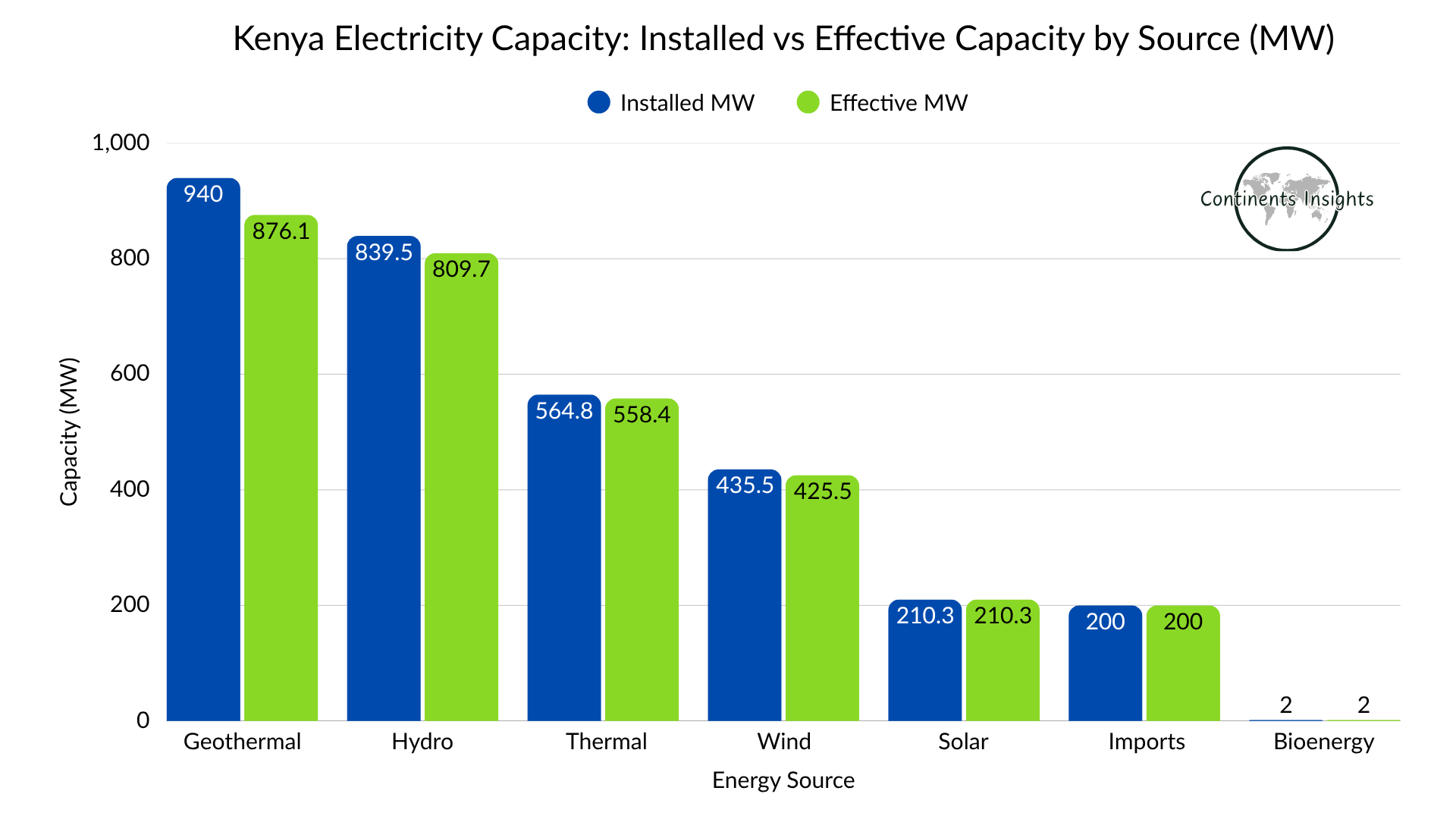
At the same time, Kenya can leverage its vast renewable energy sources in the event it proceeds with expansion. As shown in Figure 1 below,91%of electricity generation comes from renewable energy sources.
Figure 1: Kenya Electricity Capacity: Installed vs Effective Capacity by Source (MW)
Source: EPRA
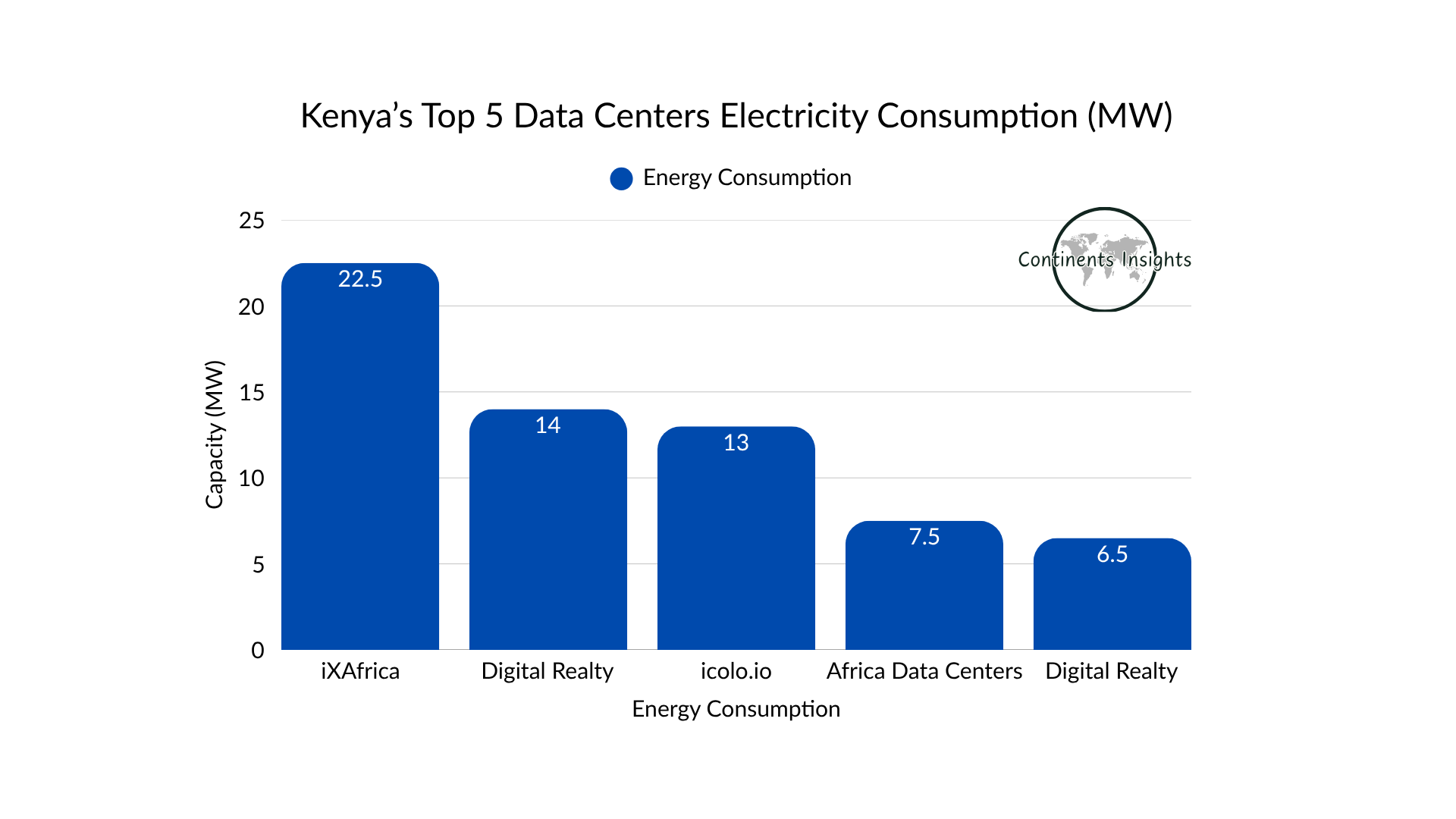
As noted above, Kenya hosts 19 data centers and available data suggests that the largest one which also serves the region 22.5MW. Kenya’s facilities are majorly concentrated in Nairobi and Mombasa. Nairobi remains Kenya’s technology hub while Mombasa remains ideal for its access to the international submarine internet cables. Government reports also indicate that Nairobi and the Coast regions consumed the most electricity as of 2025.
Figure 2: Kenya’s Top 5 Data Centers Electricity Consumption (MW)
Source: OCOLO
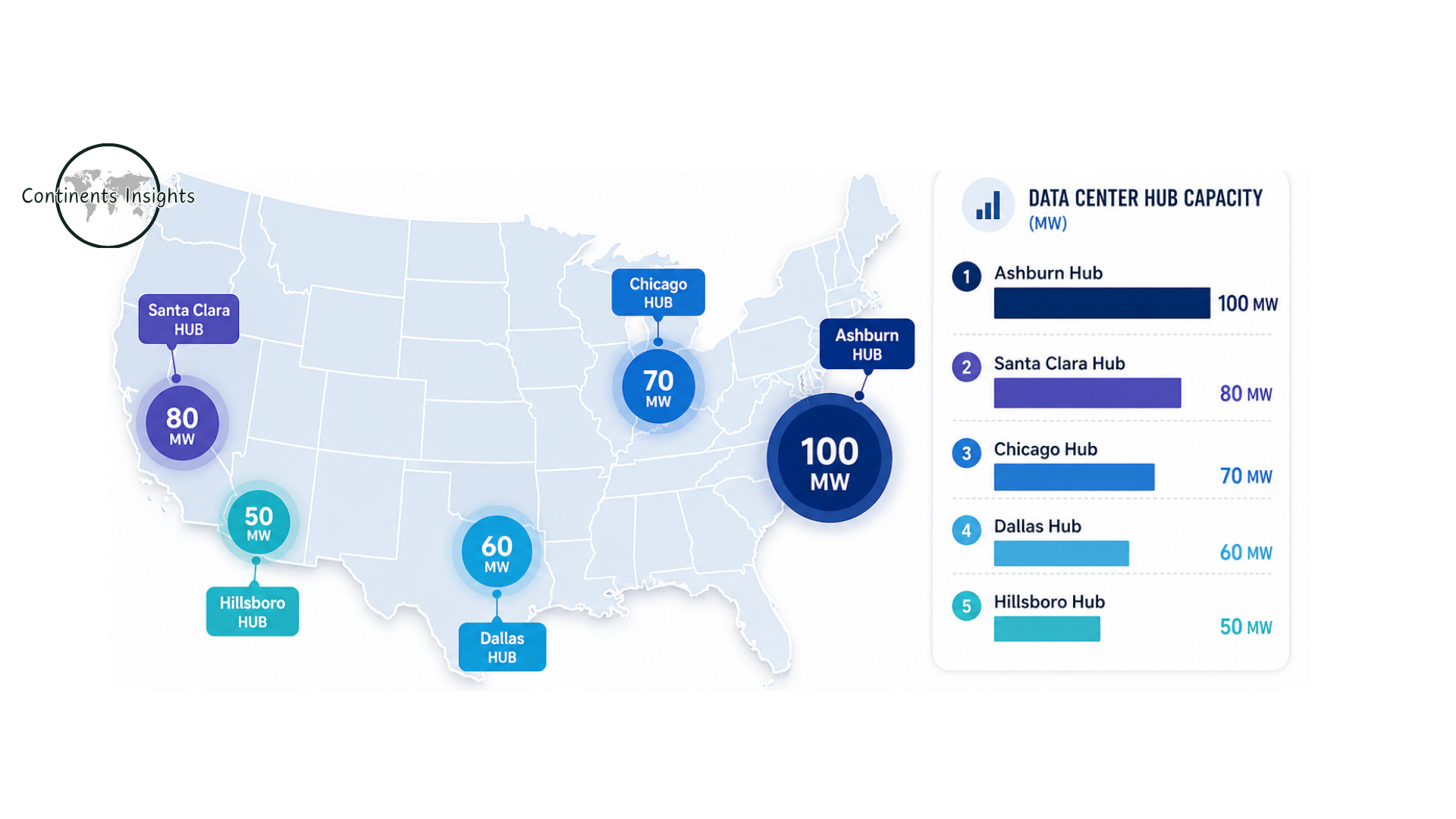
By comparison, in the United States – where the market is significantly larger – even the fifth-largest hub consumes 50MW – two times more than Kenya’s largest data center. The country also benefits from a highly distributed network of facilities across multiple regions, including major hubs such as Ashburn, Dallas, and Silicon Valley.
Figure 3: America’s Largest Data Center Hubs
Source: Continents Insights
As Africa, Kenya included, anticipated further data centers growth, greater investment in electricity infrastructure, generation and access. Infrastructure should first serve citizens, function as a public good, and meet basic development needs before large-scale expansion proceeds unchecked.
There are also lessons from abroad. In some countries, communities have raised concerns over water usage linked to data centers, a particularly relevant issue for African states where drought is recurrent. In the United States, there have also been complaints that new energy infrastructure built to support data centers has contributed to rising power prices.
For a continent still working to secure reliable electricity, clean water, and sanitation for all, priorities must be clearly defined. If data centers are to become a strategic priority, African governments must also recognize that they are entering a highly competitive global race.
With thanks to Paul Kairo for assistance in collecting the data used in this article.
[1] Parallel processing is when a computer performs multiple calculations or tasks at the same time instead of one after another. Rather than using a single processor to complete Task A, then Task B, then Task C (serial processing), parallel processing splits the work across multiple cores, CPUs, GPUs, or machines so tasks happen simultaneously.
[2] Traditional cloud data centers run normal internet services, so they produce moderate heat and are usually cooled with air systems like fans and air conditioning. AI data centers use powerful GPUs that generate much more heat in a smaller space, so air cooling is often not enough. That is why many AI data centers use liquid cooling to keep the machines from overheating.